 Lingualite
Why Studying Abroad Still Wins — and How to Simulate It at Home
Full immersion is the fastest path to fluency, but you do not have to book a flight to get most of its benefits. Here is how to recreate the pressure, variety, and real-world context of language immersion from wherever you are.
11 min read
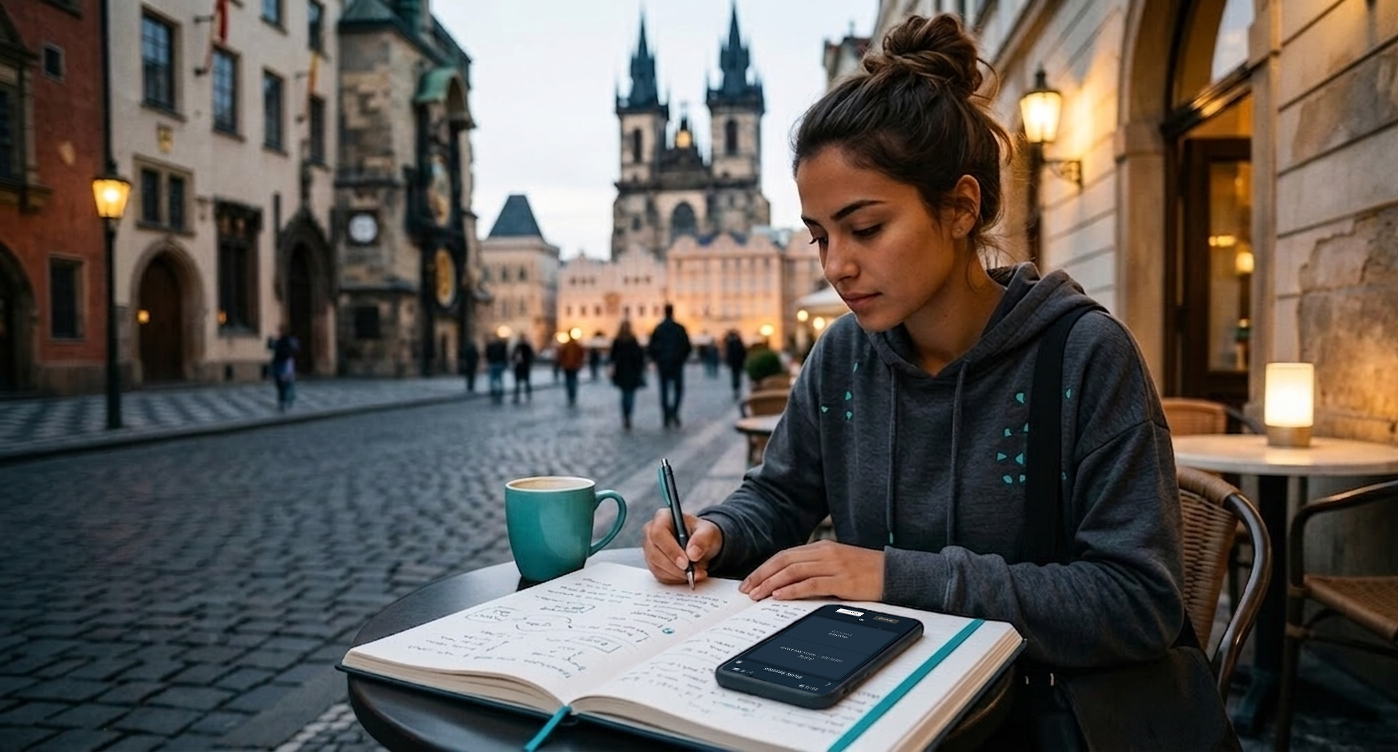
Ask anyone who has actually become fluent in a second language — really fluent, not tourist-survival fluent — and they will almost always have a story about a specific place. A year in Barcelona. A summer in Kyoto. A semester in Berlin. There is something about physical immersion that no app, no class, no private tutor has ever been able to reproduce.
The reason is not mystical. It is structural. Immersion works because it changes the cost of not using the language. And most language learning fails because there is no cost at all.
What actually makes immersion work
Three things happen when you move to a country whose language you want to learn, and none of them are things you can fake with ten minutes of Duolingo a day.
Consequence. You cannot order food, rent an apartment, ask where the pharmacy is, or make a friend without using the language. Every interaction has a real outcome attached. This is not motivation — it is compulsion. Your brain pays attention because it has to.
Volume. You are exposed to the language for fifteen hours a day. Overheard conversations on the bus. Signs on shops. The radio in a taxi. The chatter in a cafe. This passive exposure adds up. Patterns that take a textbook weeks to teach become intuitive in days.
Variety. Every speaker is different. Accents, dialects, speaking speeds, vocabulary. A classroom gives you one teacher. A city gives you a thousand. Your ear adjusts to the full range of how the language is actually spoken.
Why you should still try to simulate it
Not everyone can move to Madrid for a year. That is fine. The three mechanics above — consequence, volume, variety — are reproducible with enough intention. You just have to stop relying on apps alone to carry you and design your own immersion environment.
Manufacturing consequence
This is the hardest of the three to fake, and the most important. You need interactions where not using the language costs you something.
Language exchange partners
Find one person you speak with weekly. Tandem, HelloTalk, and italki are the usual platforms. The key is commitment: if you cancel, they are disappointed. That social weight is the consequence.
Paid tutors
Paying for a tutor adds financial consequence on top of social. The cost is enough to make you prepare for the session.
Classes with other students
The weakest form of consequence (you can hide behind the other students) but the easiest to sustain. Group classes at local institutes or community colleges work if you have them nearby.
Manufacturing volume
Volume is the easiest lever to pull. Fifteen hours a day of exposure is impossible at home, but two to three hours is achievable.
Change the language of your devices
Your phone, laptop, streaming apps. Swap them to your target language. You will not understand every menu item at first. You will within a week.
Background listening
Podcasts, radio, and YouTube in the target language during commutes, dishes, walks. Your conscious attention is elsewhere, but your ear is training. This is the rough equivalent of overhearing conversations on a bus in a foreign city.
Reading, constantly
News headlines, social media, subtitles on shows. Short, frequent exposure beats long rare sessions. Aim for fifteen minutes of reading, three times a day, rather than a single hour on Sunday.
Manufacturing variety
Classroom-only learners develop a weird flaw: they can only understand their own teacher. Everyone else — different accent, different speed, different vocabulary — sounds like gibberish. The antidote is deliberate exposure to many voices.
Rotate podcasts
Listen to one podcast until the hosts feel familiar, then switch. Different hosts, different genres — news, comedy, interviews.
Watch unscripted content
Reality shows, vlogs, interviews, cooking shows. Natural speech, unrehearsed cadence. Scripted dramas are useful too but tend to be slower and clearer than real conversation.
Regional variation
If you are learning Spanish, do not only listen to Mexican Spanish. Listen to Argentinian, Spaniard, Colombian, Chilean. The variants are striking.
The role of vocabulary
None of the above matters if you do not understand enough words to follow along. This is where the traditional study work still has to happen. You need a vocabulary base before the immersion environment can teach you.
Roughly: 1,000 words gets you partial understanding of simple content. 3,000 words gets you basic conversational comprehension. 5,000 words is where real content — news, podcasts, shows — starts to click. Below 1,000 words, immersion feels like standing in a waterfall of meaningless noise.
This is where a flashcard-based app like Lingualite fits into the immersion strategy. You use it to build the vocabulary base. You use the manufactured immersion environment to train the ear and the reflexes around that vocabulary. Neither works alone.
A three-month plan
- Daily flashcard review — 15 minutes, consistent.
- One tutor session per week — 30 to 60 minutes.
- Background listening — 30 to 60 minutes per day, attention optional.
- One piece of real content daily — an article, a scene from a show, a song lyric. Extract new vocabulary into cards.
- Device language — fully switched from day one.
Do this for ninety days and you will have gotten the majority of what a three-month study-abroad trip would have given you. The last 20% — the accent, the cultural fluency, the friends — still requires plane tickets. But the core of it, the structural immersion, is buildable from your own living room.
Start building your vocabulary
Lingualite turns the content you are already consuming — articles, shows, podcasts — into review-ready decks.